
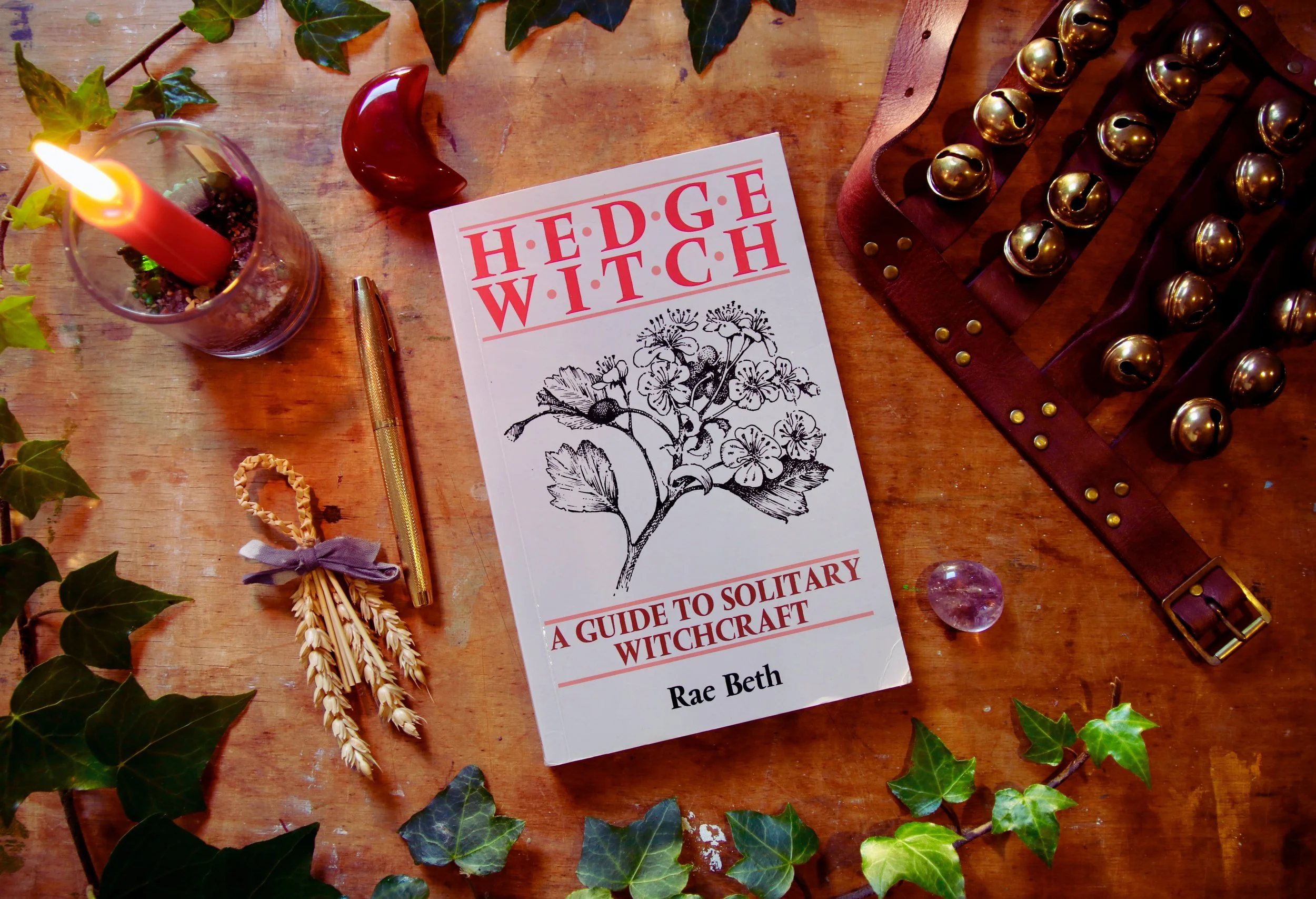
I was deeply affected to hear about the passing last week of Rae Beth, the author whose beautiful book, Hedge Witch was so influential to me—especially in the formulation of hedge morris dancing— and whose warm support and correspondence in recent times was both a blessing and an honour.
It’s perhaps a little counterintuitive for someone so apparently unsentimental about folklore to have found such inspiration in the work of a writer as arcane and transcendent as Rae, but even to a handwringing agnostic like me, her words always felt like home.
I’ve written before about how I came across Hedge Witch as a lonely student hanging around York’s new age shops in hopes of finding sympathetic kin in a new city. It's probably fair to say I was a bit of an oddity in my stolid agricultural community, and in those pre-smart phone days, places like that—thick with sweet-smelling incense and the sound of panpipes—felt like a portal to another world (or at least suggested that another way of living might be possible).
I feel like I leafed through the paperback several times before committing to part with my money. Drawn by its pale pink cover (still my go-to colour) and intrigued by the promise that it contained wisdom about a nature-based spiritual practice that might be enacted even in solitude, I remember the tiny thrill it was to put in my bag, somewhat illicit for someone raised in rural High Church.
And then I went home and read it from cover to cover, revisiting it many times since. Here’s what I love about Hedge Witch. I love how generous it is, presented in an epistolatory style, comprised of real letters written by Rae to two novices over the course of about a year in 1987/88 (one goes on to self-initiate as a hedge witch, the other does not). As a reader, it’s like receiving letters from a trusted friend; warm, engaging, informative without being overwhelming and always, always non-dogmatic.
I also love how accessible Rae's hedge credo is. It feels eminently do-able, inclusive of those with little more than a pot plant to tend and a window to look at the sky. Although it’s not stated outright, her teaching is very neurodivergent / disability-friendly, fully embracing of the wide array of reasons someone might not feel able to join a group—something which informs my own approach to creating contemporary traditions.
She writes, ‘there is a certain kind of witch at home with solitude. He or she need not be friendless. But by temperament, some are drawn to worship and work magic on their own’—an affirmation of acceptance for an introverted only child like me. At the same time, her willingness to address practical concerns was reassuring for a low-income fledgling juggling study with several part-time jobs: ‘[i]f you lack money or have children to consider, or if you have a demanding job...then it is really not feasible to celebrate the Sabbats and Full Moons regularly, at someone else’s choice of hour in someone else’s house, some distance from your home’.
That Rae Beth lived as a hedge witch and described her world with such richness made these things feel not just valid where they might often be condemned or pitied, but noble and abundant: ‘[t]hough this is sometimes a lonely path,’ she admits, ‘it leads to places of great beauty.’ Her clear environmental and feminist consciousness also shines throughout: I thrilled at the idea of a Mother Goddess as well as a masculine God and the cultivation of respect and adoration for the earth we inhabit, rather than longing for some sky-bound other-place only earned in the afterlife. ‘To be fully alive is worth everything. Such open sensitivity can entail suffering, but joy is real.’
Although Wicca didn’t really stick for me, at least in any declarative way, Rae’s work taught me to intuitively craft a pathway and relationship to the divine that works for me, something I continue to practice in my own haphazard sort of way. It also cemented my fierce commitment to being self-determined (although it took me some years to really understand what this meant).
A couple of years ago when I was reconnecting with my morris dancing practice—something which had never previously held any emotional, much less mystical meaning for me—I returned to Rae’s interpretation of ‘hedge’—used with reference to the hedge schools, hedge priests and hedge marriages of the past—to imagine an independent, unsanctioned and uninstitutionalised folk which sought to include everyone.
Her kind words and encouragement at what she called my ‘hedge witchcraft [with] a new twist’ were a huge endorsement and we went on to exchange letters and emails sporadically over the past two years, something my teenage self would certainly never have believed. One such message from last year said, ‘Your creativity and inclusiveness are a joy in this difficult time. Although I am now a wonky old lady, I shall certainly be joining in with the Dusking Dance.’ Later she emailed to say that she'd incorporated it into her Samhain observances. I hope I told her how much this meant to me.
We never met and I realise now in writing this that I know relatively little of her life outside of her books (not just Hedge Witch but also The Green Hedge Witch, The Hedge Witch’s Way and others). I don’t even have an author photograph to share, it being her preference, like many older, traditional witches to avoid such representations. So I want to finish with Rae’s words on loss, as her friends and readers reflect on the many gifts she left us with:
‘Remember, “You must meet, and know, and remember, and love them again”’.
Thank you Rae Beth. You will be sorely missed.
—December 2025